B r a i n C l e a r

Sorting through life one thought at a time

Category: Real Life

  • Does the Bull Fit in the Barn?

    A friend of mine has a daughter heading into her final year of college. This daughter has had exactly one boyfriend the whole time. They got together a few months into freshman year and never really stopped.

    We got to talking about what comes next. The daughter wants a gap year before med school, and she and her boyfriend have floated the idea of getting a place together. He’s staying in school. No gap year for him.

    My friend wasn’t thrilled about the living-together part. Her worry: if her daughter moves in, he’ll have less reason to ever propose.

    I’ve been in the U.S. for years now. Long enough that I don’t expect much to catch me off guard anymore.

    And yet.

    There’s a specific flavor of surprise that only American dating logic can produce in me, and this was one of those moments.

    Come again?

    Because to me, the reasoning runs completely in reverse.

    It reminded me of that phrase people trot out here:

    “Why buy the cow when you can get the milk for free?”

    I have thoughts.

    Starting with this one: since when is he the customer and she the livestock?

    And why does the saying assume she’s just standing at the fence, waiting to be deemed purchase-worthy?

    Where I’m from, nobody’s buying anybody.

    Both people are choosing.

    If we’re going to keep the barnyard metaphor alive, maybe it should go like this instead:

    Why would a woman commit to a bull before finding out if he even fits in her barn? 😂

    Moving in together was never supposed to be a bargaining chip, something she trades for the promise of a ring down the line.

    It’s just how two people figure out if a life together actually works.

    And honestly, this goes well beyond the roommate question.

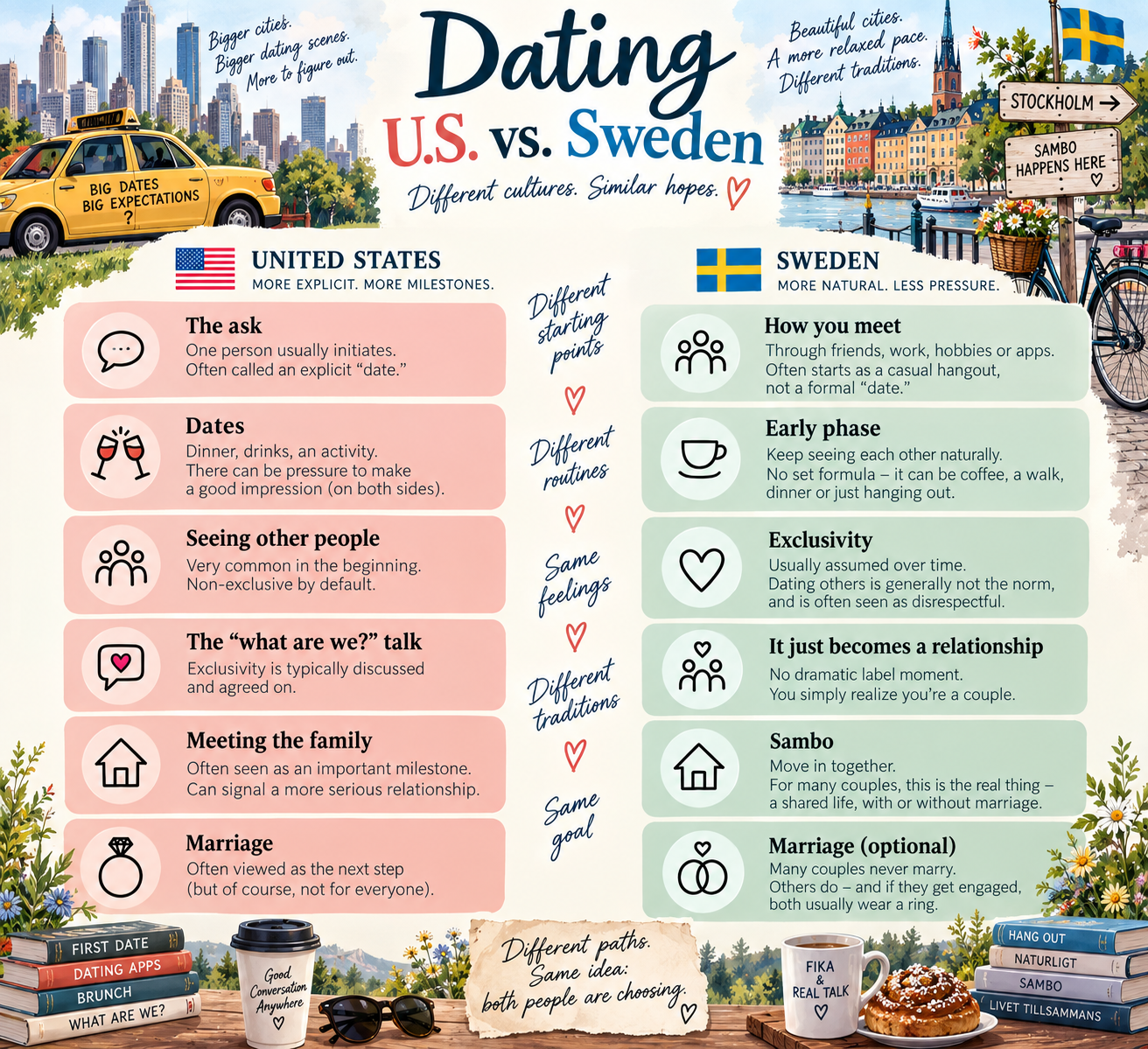
    The longer I sat with it, the clearer it got. Sweden and the U.S. aren’t just doing dating differently. They’re starting from different premises entirely.

    To be fair, Sweden isn’t game-free. Some version of “don’t seem too eager” is probably universal. It’s been a while since I was in the dating pool back home, but I’d guess the instinct to play it cool hasn’t gone anywhere.

    Women in particular seem tasked with the same balancing act everywhere: be interested, just not too obviously.

    Sweden included. We’re not exempt.

    But the actual mechanics of dating feel less scripted there.

    Two people meet. They start spending time together. They sleep together.

    Or, honestly, they might sleep together first and the “spending time together” part follows. 😂

    Sequence aside, here’s the real difference: nobody typically has to schedule a sit-down conversation titled “So, are we exclusive?”

    Once you’re seeing someone regularly, exclusivity is the default setting. If that’s not the case if someone else is in the picture too that’s the part you actually have to bring up.

    I’ve got a much younger sister, which means I’ve watched Swedish dating unfold long after I aged out of it myself. What I’ve noticed is that when someone isn’t looking for anything serious, or wants things kept casual, that gets said out loud early, precisely so nobody ends up confused or hurt.

    The American version often runs the opposite direction.

    You can be dating, sleeping together, spending every weekend together, and somehow still need a formal check-in about whether either of you is doing that with anyone else, too.

    My Swedish nervous system finds this baffling.

    Then there’s the friends-and-family piece. In Sweden, meeting someone’s friend group isn’t loaded with meaning. Meeting the parents isn’t a milestone with a flashing sign over it either.

    Sometimes you’re just around, long before anyone would call you the girlfriend or the boyfriend.

    And that same casualness carries all the way through, right up to the question that kicked off this whole train of thought: marriage.

    The old cow saying isn’t really about timing. It’s about the fear of never getting picked at all about being the one left standing at the fence while somebody else decides if you’re worth the commitment.

    I’m sure that fear exists in Sweden too. People are people, and relationships can make all of us insecure. But the idea that a woman shouldn’t move in with a man because it might make him less likely to marry her feels very foreign to Swedish culture.

    Living together before marriage is simply the norm. The idea of proposing to someone you haven’t lived with first would feel almost backwards.

    Marrying someone means formalizing two lives you already know fit together, not making a leap of faith and hoping the daily reality works out.

    Sambo, the word for living together, isn’t a stepping stone toward the “real” thing. For a lot of couples, it basically is the real thing, just without the paperwork. People buy houses, have children, build entire lives together and may never get married at all. Nobody is necessarily waiting for the next step.

    And even engagement looks a little different.

    In Sweden, when you get engaged, both people wear a ring.

    Traditionally, the rings are engraved with your partner’s name and the date you got engaged, signaling the commitment you’ve both made to the relationship.

    When you get married, the woman gets a second ring. The man often keeps the same ring it’s taken off for the wedding ceremony and put back on, with the wedding date added to the engraving.

    Sweden has definitely become more Americanized when it comes to engagements. There are more diamond rings and elaborate proposals now than I remember growing up.

    But the man still gets a ring.

    And usually, even if the proposal itself is a surprise, the idea of getting married isn’t.

    They’ve talked about it along the way. Both people already know this is where the relationship is heading.

    The proposal might be a surprise.

    The answer probably isn’t.

    And maybe that’s why another American question has always sounded a little strange to me:

    “Why hasn’t he married her?”

    Not why haven’t they gotten married?

    Why hasn’t he married her?

    It’s such a tiny difference in language, but there’s an entire relationship script hiding inside it.

    He’s the one deciding.

    She’s the one waiting.

    He’s choosing.

    She’s hoping to be chosen.

    And suddenly we’re back at the cow.

    Of course Swedish women want love and commitment. Of course people wonder where relationships are going. And yes, we can make ourselves completely insane over another human being too.

    We’re Swedish. We’re not some emotionally evolved Nordic species. 😂

    But underneath all of it is an assumption I grew up with that I never really thought about until I lived somewhere else:

    Both people are choosing.

    Maybe that’s the part that gets lost in the cow-and-milk logic.

    A woman isn’t giving a man the benefits of a relationship and hoping he’ll eventually reward her with marriage.

    They’re both trying the relationship on for size.

    They’re both deciding.

    They’re both committing.

    And if they get engaged, they’re both wearing the ring.

    Forget about buying the cow and getting the milk for free.

    I’m still stuck on a more important question:

    Does the bull even fit in the barn? 😂
  • An Update From the Spider HOA

    Yesterday I cleared a few spiderwebs off the patio up in the north GA mountains.

    For the record, I have nothing against spiders. They’re good to have around, they eat bugs, they build genuinely impressive webs, they mind their business. I only asked one thing:

    Please don’t build across the spots where I walk.

    Cool, well, that request got denied.

    This morning several webs were already back up. Overnight. No permits, no contractors, nothing. Just fully rebuilt structures like it was nothing. Mildly impressive honestly. One even had a tiny spider chilling in it, so I guess they’re doing affordable housing now too.

    Tried to get a picture but the green background, my phone refusing to focus on an actual spider, and my frenchie barking at me the entire time made it basically impossible to document.

    So here’s where the Spider HOA and I landed:

    You can stay. Eat the bugs. Build your webs, I respect the craftsmanship.

    But if it crosses into my walking path, I’m knocking it down, no notice.

    We’ll see what they’ve got tonight 😂

  • Things You’re Not Supposed to Complain About

    Apparently, there are certain things you’re not supposed to complain about.

    Traffic is one of them.

    Sleep is another.

    Unfortunately, I currently have complaints about both.

    This week, it took me almost two hours to get to work. The first hour was just my normal commute, which already feels like I’ve completed a small task before I’ve actually arrived at the place where I’m supposed to do tasks.

    Then I got to my exit.

    There had been an accident, and traffic was backed up for what looked like at least a mile. I sat there for almost another hour.

    At first, I was remarkably reasonable about it. There’s been an accident. Someone is probably having a much worse morning than I am. Getting irritated isn’t going to make the cars move any faster. I’ll listen to something. It’s fine.

    I was fine.

    And then I noticed the left-turn lane.

    Cars were sailing past all of us who had been sitting there, patiently waiting in the lanes that actually went where we were trying to go. One after another. They’d drive all the way to the front and then force themselves back in.

    At first I just noticed them.

    Then I started judging them.

    Then I started keeping track of them.

    Then I could feel the heat rising.

    I wanted to honk. Not because honking would accomplish anything. Obviously it wouldn’t. I just wanted them to know.

    I SEE YOU.

    This was when I noticed something slightly alarming .

    I might be turning into my mother.

    My mother’s road rage is legendary in our family. This is not classified information. She knows it. Her children know it. I’m reasonably certain a few motorists in Sweden know it.

    She’s also usually not wrong. Someone is following too closely? That’s dangerous, you need room to brake. Someone is doing something stupid in traffic? They probably shouldn’t be doing it.

    It’s the delivery where Mom and I differ.

    I might think, that person is following way too close.

    Mom has been known to arrive rather quickly at MOTHERFUCKER.

    All of her children tease her about this.

    And yet there I was, sitting in Atlanta traffic, watching what felt like the hundredth car cruise past me in the left-turn lane, feeling my internal temperature steadily rising.

    Oh no. Is this how it starts?

    Fortunately, I remembered First Date Follow Up. It’s a radio segment where someone goes on a first date, is certain it went wonderfully, and then can’t understand why the other person has vanished off the face of the earth. They call the missing date to find out what went wrong.

    It is ridiculous.

    It is also extremely entertaining.

    And, ironically, my mother is the one who told me about it.

    So apparently my mother provided both the genetic predisposition toward road rage and the treatment for it.

    I turned it on.

    Within a few minutes, instead of monitoring the left-turn lane like an unpaid traffic enforcement officer, I was deeply invested in why some stranger wasn’t getting a second date.

    The cars were still cutting in. Traffic was still barely moving. Nothing about my actual situation had changed.

    But I had stopped caring quite so much.

    By the time I got to the office, I was exhausted. Which seems ridiculous, considering I’d spent the previous two hours sitting down. But apparently trying not to lose your shit in traffic takes energy.

    So yes, I’m complaining about traffic.

    And while I’m breaking the rules, I’ve also been woken up around 3:30 or 4:00 in the morning three nights in a row.

    Traffic and sleep.

    Two things nobody wants to hear you complain about.

    I’ll try to come up with something more interesting next time.

    In the meantime, if you see me sitting in traffic, talking angrily to people who cannot hear me that’s just the family gene showing up.

    I’m still in the early stages.

  • Vendor Speed Dating

    A couple of weeks ago, a woman reached out to me on LinkedIn about an invite-only event: leaders from the data and AI world, sitting down for roundtable discussions on data strategy, AI, and where the two are headed.

    “Blending peer perspectives with real-world approaches,” the invite promised.

    Sounded interesting. Totally up my alley.

    I noticed they specifically weren’t inviting salespeople.

    Now I know why. 😂

    Walking into a room full of strangers and making small talk is not exactly my idea of a good time, so I was hesitant. But the subjects sounded too good to pass up, so I went.

    I got seated with two other people, one from Microsoft and one from HP, both at companies about the same size as where I work. We hit it off immediately, mostly by admitting we’d each almost bailed, and then by discovering we all wore Oura rings.

    None of us knew what was coming.

    There was a stack of papers on the table. It looked like we were supposed to rate something. I didn’t think much of it.

    Then it became clear.

    Speed dating. Basically.

    Except instead of asking what you like to do on weekends, they ask about your data architecture. And instead of deciding on a second date, you’re deciding whether your company needs their software.

    Eight vendors. Every 10 to 15 minutes, they rotated from table to table. Pitch their product, ask about our problems, explain how they could fix them.

    Yes, I realize this is also known as a sales pitch.

    Luckily, the woman from HP had an actual use case, so I mostly sat back and watched vendor after vendor take a swing at solving it.

    Ding. Next vendor. Ding. Next vendor. Ding. Next vendor.

    This went on for a couple of hours, after a full workday.

    Here’s the thing, though. I’d spent all this time before the event wondering if I’d be out of my depth. Would everyone else know more than me? Be more fluent in AI strategy and governance and all the impressive-sounding stuff?

    Instead, I noticed something I didn’t expect: we are all trying to figure something out.

    People from massive companies were stuck on the same kinds of problems, fishing for the same kinds of answers, sometimes just sitting there letting someone else do the talking, same as me.

    That was worth more than anything any vendor pitched.

    A bell rang for dinner. I’d made enough professional connections for one evening.

    I left.

    No dinner, no new software.

    Just slightly less impostor syndrome, a funny story to tell at work, and a few new LinkedIn connections.

    I’ll take it.

  • Life as an Analyst

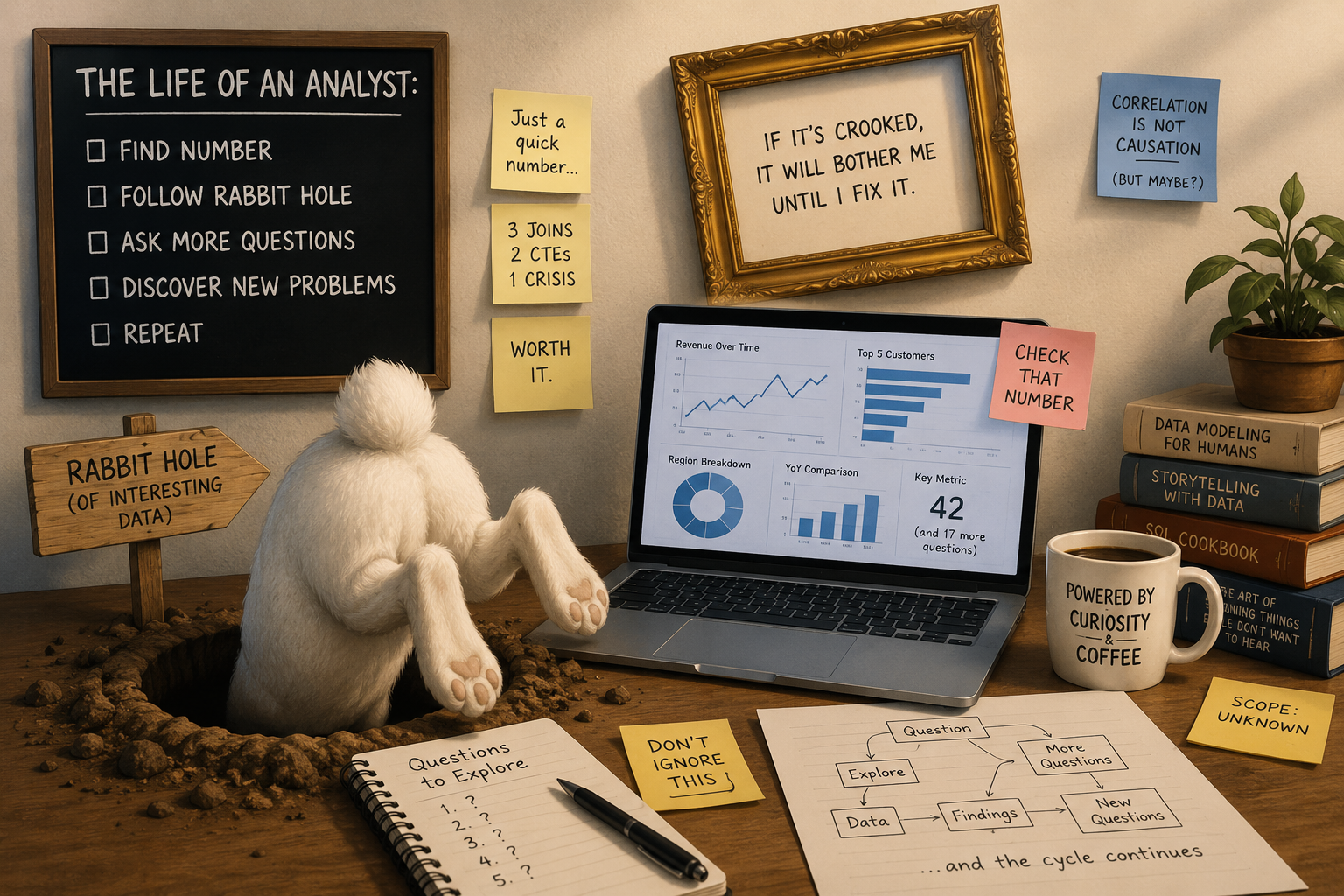
    The truth is, we spend most of our days trying not to follow every interesting rabbit hole the data puts in front of us.

    Someone asks for “just a quick number,” and three joins, two CTEs, and one existential crisis later, we’ve found it—along with four other numbers nobody asked for but that we now can’t stop thinking about. We tell ourselves we’ll ignore them. We do not ignore them.

    Case in point: I sat down last Saturday morning to look at one weird number. Four hours later it was afternoon, I still hadn’t finished, and nobody on earth had asked me to work on a Saturday. That’s not dedication. It’s curiosity… with questionable boundaries.

    I’ve always loved puzzles. Crossword puzzles, logic puzzles… it doesn’t really matter. I don’t even mind asking for a clue now and then. The fun isn’t knowing the answer. The fun is figuring it out.

    That’s probably why I became an analyst.

    The truth is, half our job is explaining that correlation isn’t causation, while the other half is secretly hoping it is—just this once. It would make the story so much cleaner.

    People think analysts spend their days building reports and dashboards. We do. But what we really do is ask questions.

    Why is that number different? Why did it change? Should those two reports match? What happened here?

    Every dataset tells a story. Our job is figuring out what it’s trying to say.

    We build dashboards that we genuinely hope will help people make better decisions. Sometimes they do. Sometimes they’re opened once, admired for thirty seconds, and never seen again.

    The truth is, nobody actually wants the raw data. They want the one number that confirms what they already believed walking into the meeting.

    We know this. We give them the number. Then, gently, we show them the other numbers.

    This is called being thorough. It’s also called hope.

    Every “quick question” is a Trojan horse for a two-day project, and we say yes anyway—not because we have to, but because we’re curious like that. Somewhere between the fifth JOIN and the sixth GROUP BY, this stopped being a job requirement and became a personality trait.

    We don’t fix the data because someone asked us to. We fix it because leaving it wrong feels like leaving a picture frame crooked on someone else’s wall. It nags at us until we fix it. Or maybe that’s just me.

    I didn’t finish that Saturday problem in one sitting, by the way. I came back to it Sunday. I’m still a little annoyed about it.

    Maybe that’s the real job description nobody puts in the posting.

    Not “Proficient in SQL, Power BI, Tableau, SSIS…”

    Although yes, preferably someone who can also remain reasonably calm at 11 p.m. when a package fails for reasons the error log refuses to explain.

    No.

    The real qualification is curiosity.

    Someone who can’t walk past a number that doesn’t quite fit without wondering why.

    The most honest conversation in any company happens in a footnote that says, “Excludes outliers.”

    Almost nobody reads it.

    We read it. We wrote it. We know exactly which outliers were excluded, why they were excluded, and we probably have strong opinions about whether they should have been excluded at all.

    That’s the quiet, slightly obsessive, deeply curious life of an analyst.

    Chasing the number nobody asked for. Straightening the picture frame nobody noticed was crooked. Following one more rabbit hole than we probably should.

    Because every unexpected number tells a story. And every story begins with someone curious enough to ask one more question.

    Our minds aren’t wired to stop at the answer. They’re wired to wonder what else we might be missing.

  • Peanut Butter Toast

    Some favorites never change.

    When I woke up this morning, I knew I wanted to write something.

    Here’s the thing: I have a long list of subjects and ideas for future posts, but they all seem perfectly happy staying on that list. They rarely volunteer to become an actual blog post.

    So, I wandered into the kitchen to make myself something to go with my coffee.

    Peanut butter toast.

    I’m trying to remember when I got hooked on it. It definitely wasn’t growing up because peanut butter wasn’t really a thing in Sweden when I was a child. Somewhere along the way it found me, and apparently decided it wasn’t leaving.

    If you ask me what my favorite food is, there’s a good chance I’ll say peanut butter toast with sliced bananas.

    Which is funny, because I’m actually a foodie.

    Food has always been a big part of life in my family. We made a celebration out of good meals, and whoever had cooked was praised as if they’d just won a Michelin star. I still love trying new restaurants, new cuisines, and dishes I’ve never had before, and one of my favorite parts of traveling is discovering local food.

    There’s something special about that first bite of a meal you know you’re going to love. I swear it sends little feel good signals all over your body.

    A while back I won a prize at work, and they interviewed me for the company newsletter. One of the questions was, “What’s your favorite food?”

    Without thinking, I answered, “Peanut butter toast.”

    I’m pretty sure they expected something a little more exciting.

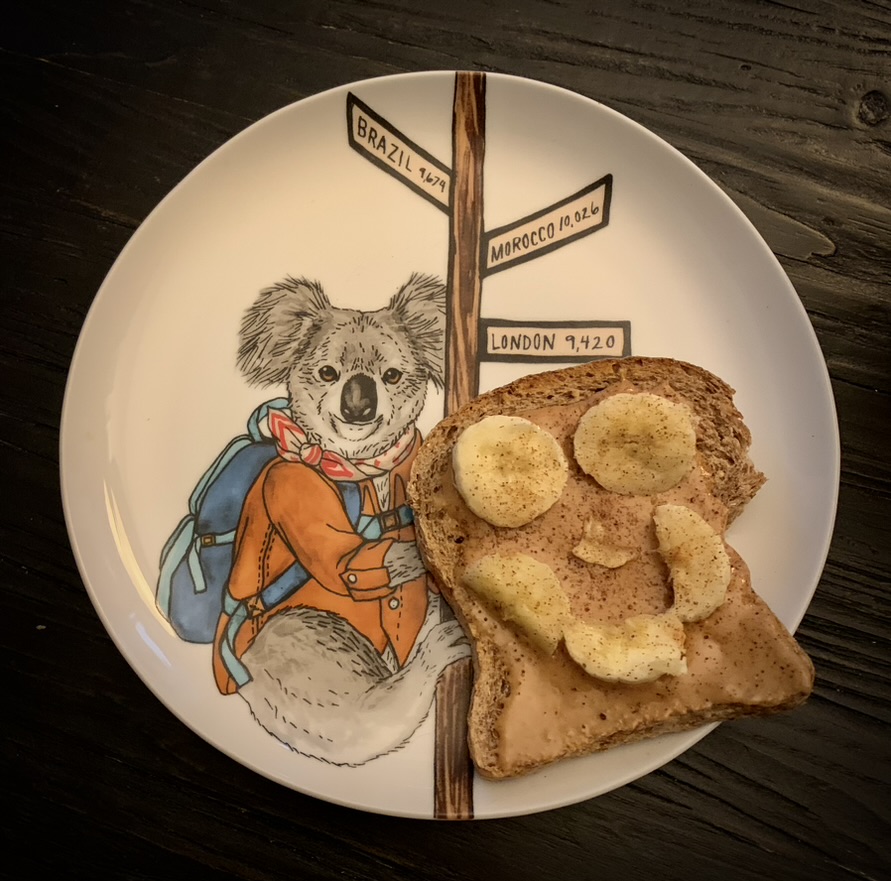
    The picture I sent to work when they asked for my favorite food: peanut butter toast and bananas, on my favorite koala plate.

    It’s hard to pick just one favorite — avocado’s a close second (if I see it on a menu, I’m probably ordering it before I finish reading the description), and peanut butter with chocolate is its own category of unbeatable. But none of that changes the answer I keep coming back to.

    As I stood there this morning with my coffee and peanut butter toast, I started thinking about comfort food.

    It’s funny how some foods stay with us through the years. Not because they’re fancy or impressive, but because they never disappoint. They taste exactly the way you expect them to. They make an ordinary morning feel just a little bit better.

    For me, that’s peanut butter toast with sliced bananas.

    Simple.

    Reliable.

    And somehow… still perfect.

  • The Rabbit Hole of Overthinking

    “I was thinking maybe, someday, I’d like an electric car. Five minutes later I was calculating battery production, worrying about climate change, imagining my dogs overheating, and wondering what kind of planet my nieces and nephews will inherit. Meanwhile, my perfectly good car was sitting in the garage wondering what it had done wrong.”

    Anyone else’s brain take the scenic route?

  • Sunday Funday

    Every Sunday I become the CEO of Good Intentions.

    My agenda includes meal prep, organizing, exercising, watering the plants, answering texts, reading a book, and somehow relaxing.

    I got up at 6 a.m. with a solid plan:

    Walk the dogs and get some work done before my 9 a.m. Pilates class.

    It’s now 11:30.

    I’ve taken the dogs on a long walk, gone to Pilates, gotten sucked into my current audiobook, spent way too much time comparing Apple Watches because mine is a Series 7, and somehow it’s almost lunchtime.

    The work I got up at 6 a.m. to do? It’s still patiently waiting for me.

    Funny how some days you can be busy for hours without touching the one thing you originally planned. Then again, the dogs had a great walk, I moved my body, and I got lost in a good book.

    Maybe Sundays aren’t meant to be efficient. Maybe they’re just meant to be lived.

    And after all… it’s only lunchtime. There’s still plenty of time to get a few things done.

    At least that’s what the CEO of Good Intentions keeps telling herself while sipping tea and making absolutely no move toward her laptop.

    Just wondering… am I the only one who creates a to-do list worthy of three people every Sunday?

  • Midsummer in Sweden

    This week, I was talking to my mom as she was preparing for Midsummer, one of the biggest celebrations of the year in Sweden, the longest day of the year.🇸🇪

    She told me about her trip to the grocery store and how, this year, she wasn’t rolling her own meatballs. That may not sound like a big deal, but rolling meatballs for a large family gathering can be quite a chore.

    There would be new potatoes with dill, meatballs, pickled herring, strawberries, and of course some kind of dessert.

    There would undoubtedly be alcohol as well. After all, it wouldn’t be a Swedish Midsummer without it.

    As she talked through her plans, I could almost picture it all. The grocery stores crowded with people buying the same ingredients they buy every year, and especially Systembolaget, the only place in Sweden where you can buy alcohol.

    Since my mom and her boyfriend were heading up to their summer house in Dalarna, and my sister would be driving up with her little boy, I reminded my mom that she should take him to one of the larger Midsummer celebrations where children dance around the midsummer pole.

    As I said it, I could vividly picture it: an accordion and fiddles playing in the background, someone standing with a microphone leading the festivities, and children hopping around the pole pretending to be frogs during Små Grodorna(The Little Frogs).

    That conversation made me think about how Midsummer has changed throughout my life while somehow remaining exactly the same.

    As a child, Midsummer was about cousins, lakes, and dancing around the midsummer pole. I spent many summers in Dalarna, where my grandparents lived. My aunt, uncle, and cousins would drive up, and we would spend hours playing, exploring, and enjoying the freedom that comes with long summer days.

    As a teenager, Midsummer became something entirely different. It was about friends, freedom, staying out too late, and, if I’m being honest, usually drinking a little too much. Like many Swedish teenagers, the holiday became less about tradition and more about celebrating the start of summer.

    As an adult, I find myself appreciating the things I once took for granted the family meals, the conversations around the table, and the comfort of traditions that connect one generation to the next.

    Living abroad, holidays like Midsummer have a way of reminding you just how far away you are.

    Not because you cannot celebrate where you are, but because you realize that somewhere else, the people you love are continuing traditions that were once your traditions too.

    Hearing my mom talk about preparing for Midsummer dinner made me realize that some holidays never stop feeling like home, no matter how many years have passed or how many miles separate you from them.

  • The Cost of Chasing a Dream

    Most people talk about following your dreams as if it’s an inspiring quote printed on a coffee mug.

    What they don’t talk about is what gets left behind.

    Leaving family, lifelong friends, a successful career, financial stability, and the comfort of knowing exactly where you belong is rarely romantic. It is messy, uncomfortable, and often terrifying.

    Recently, I came across the story of someone who made exactly that choice.

    He left Sweden, where he had built a successful career and a comfortable life, and moved to Atlanta to pursue acting. Not because it was practical. Not because it was guaranteed. But because there was a persistent feeling that there was something more he wanted to explore.

    I think many of us have a dream tucked away somewhere. Maybe it’s writing a book. Starting a business. Moving to another country. Learning a new skill. Changing careers. We tell ourselves we’ll do it when the timing is right.

    The problem is that the timing is rarely perfect.

    There will always be responsibilities, bills, obligations, and reasons to stay where it feels safe.

    What struck me most about this story wasn’t the acting itself. It was the willingness to accept uncertainty.

    Starting over means becoming a beginner again. It means building new relationships, learning unfamiliar systems, and facing the possibility that things may not work out the way you imagined. Most people focus on the outcome. Few talk about the courage required to take the first step.

    Success isn’t always measured by reaching a destination. Sometimes it’s measured by having the courage to begin the journey.

    Whether the dream is acting, writing, entrepreneurship, travel, or something entirely different, there is something admirable about choosing growth over comfort.

    Because in the end, failure is often easier to live with than regret.

    And perhaps that’s the real lesson.

    Not everyone needs to move across the world to follow a dream.

    But all of us eventually face a choice between comfort and possibility.

    The question is: what dream are you still waiting to start?


    The story that inspired these thoughts can be found here:

    Read the full article here